Wednesday, 28 October 2009

Cooking heaven with Anila

Today was the day for my vegetarian thali cookery course with Anila - I'd met her at the Real Food festival earlier this year, and swooped on her marvellous shredded mango chutney. I've never been without a jar of since. She'd mentioned that she ran cookery courses, and I signed up over the summer. She runs her courses from her home in Walton on Thames in a big and airy kitchen overlooking her garden and behind it, her allotment. My fellow course member was John - a lovely gent who claimed he wasn't a good cook because 'I only cook what I like to eat', but soon proved he was a demon in the kitchen.
First, Anila took us through all the pulses, including one I've never cooked with: toover dal, or skinned and split pigeon peas. They're the yellow ones with the shiny appearance. With these, she was going to make the dal - often served at weddings in the state of Gujarat. Many Gujaratis, including Anila, eshew onions and garlic, and instead use asafoetida (or hing) as a key flavouring. Asafoetida pongs like hell in its raw state, but mellows to add a tang when it's cooked.
The dal went into one of Anila's many pressure cookers - this one is from India and shrieks horribly every five minutes or so, like something out of Hogwarts.
I'd spotted okra in the vegetable line-up: very exciting because shame to say, I've never eaten it before because of its slimy reputation. Ha! said Anila - it only gets slimy if it gets wet. So after a quick wash, John and I carefully dried each okra before chopping them up.
Into the pan with some oil, and Anila added fenugreek seeds, hing and the okra. Then more spices and it was done.
Next up was a cauliflower curry with peas. But first, John and I snapped the stalks off green chillis and Anila peeled ginger before whipping out her Moulinex mini chopper. She apologised for the taped-up bowl but John and I both admired this bit of kit, and then discovered that we owned the same small wet and dry grinder which we loved but thought too small. This somehow merged into talk about Masterchef: The Professionals, which we'd all followed with varying degrees of delight and horror. I think this is called a meeting of minds - or maybe a meeting of stomachs.
John said that his wife would never believe that he was cooking cauliflower, so Anila and I grabbed cameras to provide photographic evidence.
Cumin is a key spice here, and the smell was fantastic. While John and I paused for a minute, Anila used one of her curry sauces to whip up a saag paneer.
Then it was time for John and I to get busy with an aubergine and potato curry. Then Anila got us chopping for a kind of Indian slaw - sambaro, or carrot, cabbage and chilli stir fry. Talk returned to Masterchef and the guys who didn't know what 'julienne' was. John's julienned carrots were pretty darned good.
Anila stir-fried the cabbage and carrot with asatofoeda, mustard seeds and turmeric - another fantastic smell whafted through the kitchen.
John's special request for the day had been Anila's samosas. He's a devotee, having sampled them several times at farmers markets. John mashed the potatoes while I scrapped them into a bowl; then Anila added peas, carrots and sweetcorn and John got down to bashing the filling into shape.

While that was happening, Anila whipped up one of the taste sensations of the day: a cucumber and banana raita.
This is a mix of greek yoghurt, peeled and de-seeded cucumber, chopped banana, a little chopped green chilli, salt and a finishing touch of mustard seeds fried off in oil. Cooling and heavenly. Before John and I got on with the samosas, Anila started on the dessert - halva. It begins with an enormous wodge of ghee (or unsalted butter) - my eyebrows shot up at the amount. It's pudding! said Anila, and I was struck by the frugality of the savoury dishes and the luxuriousness of the pud. Semolina is added to the melted butter, and as Anila stirred, it underwent amazing changes in consistency, from stiff to runny. Then it was time to add the milk and water. Anila took it over to the window for the explosive addition...
...then it was back to the stove for another alchemical evolution as the sugar went in. The mix became soft then stiff again, and a final cinnamon/cardomom spice combination finished the dish. Back to those samosas.
Very wisely, before entrusting us to the samosa pastry, Anila wanted John and I to practise our folding on paper. John was brilliant and got it first time. I was abjectly awful, getting my angles hopelessly wrong until Anila did a bit of hand holding. John stormed away, turning out some fantastic little parcels.
Eventually, we had a plate of respectable samosas - just don't look too carefully at mine.
Anila got out the deep fat fryer and popped them in to cook. Finally, it was time to make chappatis. A glug of oil is added to wholewheat flour, then in goes hot water and it's time to knead the mix. Then the dough is measured into fist-sized balls, and it's out with the rolling pins.
John and I both found this tricky but Anila, who's been rolling chapatti since she was seven, is a roti genius. The perfect circle!
John and I both got rolled our chapattis too thinly, so they didn't quite puff up like Anilas - but as she said, practise makes perfect.
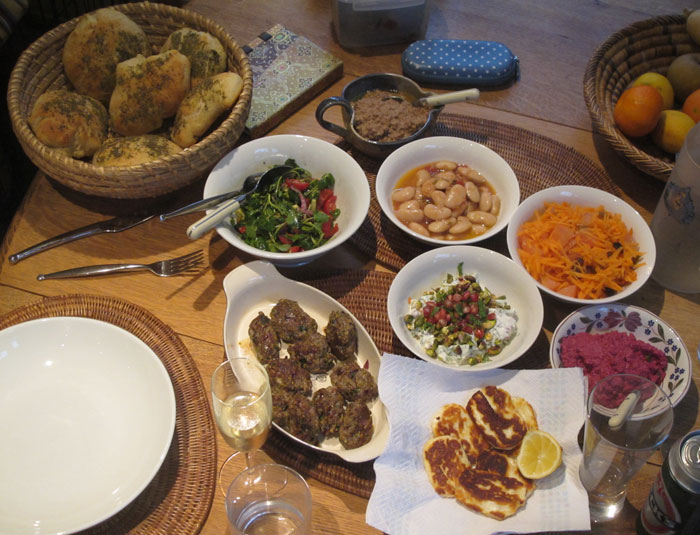
Finally, after a meditative pause, it was time to thali up. We'd cooked ten dishes in five hours, and the final thali looked superb.
One dish which Anila whipped up that I haven't mentioned is black-eyed peas in her own curry sauce - fantastic. My own favourites were the cauliflower curry, the black-eyed peas, the raita, the okra, the samosas and the halva...but it was all lovely, and a feast for the senses. I didn't have room to sample the cabbage stir fry until I got home (Anila loaded us up with doggy bags and boxes) but that's a winner too.
We certainly didn't miss onions and garlic in the food, and it's a very interesting experience to be without an ingredient that's so important in European food. A good day? You bet. A very friendly atmosphere, an uplifting learning curve with a great teacher, and a fellow foodie found in John. He's promised to sample purple sprouting broccoli if I try his favourite, steak tartare.
I returned home with some Anila pickles, chutney and curry sauces and new knowledge of Gujarati vegetarain cuisine, plus a goody bag that includes a new spice box with spices and all the recipes of the day. Thank you, Anila and John, for a memorable feast.

Saturday, 24 October 2009

Apples galore

Off into a grey and wet day for my jaunt to Chelmsford and Lathcoats Farm, thanks to a seasonal tweet from essexgourmet. Getting there was surprisingly easy, and as soon as I'd arrived at Chelmsford station, the right bus turned up to take me through Galleywood estate with its fabulously bird-named streets (Peregrine Drive, Firecrest Walk etc) and drop me just opposite the farm. Lathcoats grows over 40 varieties of apple (as well as other fruit and veg) and most of them were available to taste in the busy tasting shed. There were baskets and baskets of apples, with plates of chedder morsels to scoff in between fruit.
As soon as I paused by a basket, a knife wielder appeared to shear off a slice for me to taste. I had a long chat with one of the farm's owners, who told me about apple picking for his grandad and his garden apple tree onto which he's grafted seven varieties.
One of the apples I most wanted to taste was D'Arcy Spice, an 18th century Essex variety.
It was lovely - almost sparkling with yes, a rich spiced flavour. My apple advisor pointed me to Topaz. I was a bit snooty about this one, as it's modern and not British - but he was right.
The flavour was outstanding - almost sherbety - and the more I ate, the better it got.
Next up was Ashmead's Kernel, first recorded in 1700, and it's another lovely spicy apple. Next to it was Temptation, a french variety from a Delicious cross, but it tasted bland in comparison to the others.
Kidd's Orange, a New Zealand variety, is a Cox/Delicious cross, and was much better, with an almost jammy finish. I must have tasted around 20 varieties, and I was bowled over by the differences in taste. Truly a wonderful fruit. By now, I was appled out, so I bought some D'Arcy Spice apples and wandered over the yard to admire some of the farm's veg, stacked outside the farm shop.
Beautiful pumpkins and very painterly cauliflowers.
There was a scrum around a small tent on the other side of the yard, so I gently elbowed my way in.
There were a couple of tables with recipe leaflets and the food made from the recipes. This apple cake was particularly good.
On the other side of the tent, I joined the queue for Lathcoates single variety apple juice - make mine a bottle of Topaz. The farm had invited several of its farm shop suppliers to have a stall, including Cratfield Beef. After guzzling a couple of roast beef samples, I bagged a small joint of silverside.
I had a long chicken chat with the father and son team from Essex Birds - their rather wonderful slogan is 'chicken raised free as a bird'. They supply the farm shop with poultry, and are now rearing their big chickens for Christmas. I promised to return to the shop to see if the taste is as good as my beloved Wickham Manor Farm chooks.
I headed for the farm shop, which has a very good selection of fruit, veg, bread, preserves and dairy produce. Yet more apples in the specially cooled fruit and veg room. There were notices up explaining that one day this June, the heavens opened and all the orchards were pelleted with hail for an hour. Hence some of the apples are slightly stippled. I bought some bread and cheese, then headed out to meet a few of the animals.
This pygmy goat was on the lookout for stray food...
...but the kune kune pig was gently snoozing under a much-munched apple tree.
It was a great trip, and the farm was bustling with families, enjoying the apples, riding donkeys or getting a bite from the farm cafe. I'll certainly return. It's the kind of place that makes me feel very good about British food.

Tuesday, 20 October 2009

Apple day

A tweet from Essex Gourmet has alerted me to apple day at Lathcoats Farm in Essex this Saturday. Lathcoats is a fruit farm, and their website has a magnificent list of the 40 varieties grown there, including Adam's Pearmain from Hereford and Essex native D'Arcy Spice, which I've never heard of, let alone tasted.
The oldest apples on the list are Ashmead's Kernel (1700), Ribston Pippin (1707) and Blenheim Orange (1740). Apparently all the varieties will be there to be tasted: a very juicy prospect. The only potential pitfall to my plan to get there was yet another shutdown of the Victoria Line this weekend. But hurrah! I can nip down to Liverpool Street by overland train and get to Chelmsford from there.
My apple tree finished fruiting at the end of August, so I think I'm going to have an apple cooking orgy over the weekend...

Thursday, 15 October 2009

Squash alert

I have a serious squash infestation. They've been sneaking in via my veggie box, and three more came in from the allotment. They are now huddling together in the corner of the kitchen, muttering to each other, so it's time to pay them some attention. This is such a beautiful and patient veg: they keep for ages for use through autumn and into winter.

For supper, one baby will get the cheese and cream treatment, which I think I first saw on an early River Cottage programme, and then the wonderful Debbie of Hidden Valley Pigs served it up for lunch during a memorable piggy weekend of pork processing and fish smoking. Scoop out the seeds from your squash, reserving the top to form a lid, then fill the cavity with cheese and cream. I've used Parmesan to pack flavour into this small squash.

The oven is at gas mark 6, and it goes in for around 45 mins. And another three squash are de-seeded, seasoned and sloshed with a little olive oil. I'll deal with the roasted flesh at the weekend.
The finished cheesy squash was really lovely, and I forgot to take a photo of it until I'd scooped it clean.
All food entering the house has to pass the Mouse test.

Sunday, 11 October 2009

Damsons, cats, more soya milk and a deeply rich tomato sauce

Part two of my So Good soya milk tasting took part today, when I collared my lovely next-door neighbours, Tom and Megan, to blind taste two smoothies: one cow's milk and one So Good milk. It's my standard Sunday morning mixture of banana, honey and milk whizzed together, with the addition of the flesh of a mango I bought last week at Shepherd's Bush market. Here we have Tom swigging down glass B...
...while Megan samples glass A. They liked both smoothies, although they thought glass A, the soya version, was sweeter. Now that I've used So Good, I could tell which was which just by smelling them. In the end, and before I revealed which was which, Tom preferred the soya while Megan liked the cow's milk best. I much preferred the cow's milk...but then, I don't have that sweet a tooth and a smidgen of bias is creeping in. But clearly, So Good did work well in this experiment, and Tom happily finished off the soya smoothie.
After the romanesco cheese debacle, I'd mentioned my concern about the sweetness to Emma at Wild Card PR agency - she replied: 'In answer to your question re. why it is so sweet, all soya milks tend to be sweetened to improve the taste and make more milk like (soya beans aren’t naturally sweet). Some soya milks use fruit juice to sweeten the taste – So Good uses sucrose and vanilla flavouring. So Good held extensive consumer research to investigate the taste preferences of both soya and non soya milk drinkers. They found that the new recipe was most popular with both sets of consumer groups and was more highly favoured compared to the old recipe and its biggest competitor for creaminess, smoothness, thickness and taste.' Hmmm - maybe many of today's consumers have grown up with much more processed and therefore sweetened food than when I was a lass.
Yesterday, I spent a lovely day in the Bucks countryside with J, scrumping damsons which I cooked down and pureed to go with a fantastic lunch dessert of rice pud and a new find of J's - Tesco's Finest hazelnut yoghurt. Yummylicious. One of the many joys of visiting J is spending time with Daisy, here resting with a monkey...
...and Freida, caught here on patrol, trying to find out why J and I were laughing so much at poor Daisy.
The main cooking today has been using up the final good-sized harvest of tomatoes from the allotment and the garden. Q and I are now in digging mode, getting ready to plant onions and garlic, and clearing the ground of bean and tomato plants.
Nigel Slater had a recipe for green and red tomato chutney in last Saturday's Observer, and after much rummaging in the recycling bin I dug it out. Nigel's version is here, but I didn't have quite the weight of tomatoes - about 100g short - so I added some celery. I didn't have enough raisins either, but I discoverd some sticky prunes lurking in a cupboard.
In went the green toms, onions, raisins, prunes, sugar, salt, vinegar and a chilli from the garden. It bubbled away happily for half an hour before I added the red toms.
After a total of an hour's cooking, it looked a little bit liquid and not very jammy. And I don't think I cut the big toms into small enough chunks. Still, the flavour was fantastic, so I decided to pass the mixture through a sieve and come up with a sauce. It tastes lovely: richly sour and sweet and perfect, I reckon, for adding to some porky sausages or a jacket spud on a cold winter's day. Quite an autumnal jarful.
The sky has now turned grey so Mouse has settled into her basket while I type away.

Thursday, 8 October 2009

Sag aloo

There was a bag of spinach in my veg box this week: normally I'm a spinach purist, cooking it down and adding a dusting of nutmeg and some butter. But I'd got some left-over egg and tomato curry, lemon rice and coconut chutney, so I had a hunt among the bookshelves for ideas. Rick Stein's Far Eastern Odyssey came up trumps with a recipe from Bangladesh. I've adapted it a bit, partly because my spinach was definitely the grown-up kind that needed a brief cook before being added to the dish. The mustard notes are very Bengali.
Sag aloo (based on a Rick Stein recipe from Far Eastern Odyssey)


A good glug of mustard oil, or any light oil you have to hand
2 tsp black mustard seeds
1 tsp cumin seeds
2 garlic cloves, finely chopped
a knob of ginger, grated
1 green chilli, chopped
1/2 tsp turmeric
1 dried Kashmiri chilli
5 floury potatoes, cut into small chunks
1 leek, finely chopped
1 bag of spinach - or two good handfuls
1/2 tsp garam masala

If your spinach is mature, wash it then cook it briefly in only the remains of the washing water. Remove from the heat as soon as it's wilted down. Add the glug of mustard to a pan, then add the mustard seeds when it's smoking. Clamp on a lid to avoid the risk of being pelted with popping seeds. When the popping has stopped, add the cumin seeds a cook for a minute. Then add the garlic, ginger and chopped green chilli and cook for two minutes. Now add the turmeric and the Kashmiri chilli, followed by the potato chunks. Add about half a wine glass full of water - you don't want much - and a teaspoon full of salt.
Cook gently for around 15 minutes, shaking the pan every now and again to stop the potatoes sticking. Add a bit more water if you need to. Add the chopped leek, and when the pots are nicely soft, add the spinach and heat it through.
Turn off the heat, add the garam masala and gently stir it in.
This turned out very well, and provided a great lunchbox meal too.

Monday, 5 October 2009

Taste on trial: So Good soya drink

Last week, I got an email from Emma at Wild Card PR agency, asking if I'd like to try some So Good soya drink, as they're about to relaunch their range. Sure, I replied, if you're happy with some honest comments. No problem, said Emma, and she sent round two 1l packs of the milk in a dinky insulated bag. Included were some recipes and a fact sheet about the product. I'd asked Emma why people bought this stuff: mainly for health reasons, she said - the drink is lactose free and has no dairy ingredients but has plenty of added vitamins and nutrients.
Mouse took care of border control. I've often seen soya milk in the chiller cabinet, and I've never been tempted to buy it. My normal milk is organic unhomogenised full milk, delivered twice a week, so I wasn't sure whether to treat So Good as a milk substitute or an entirely new food substance. In the end, I decided to try to do both. So this is the first of several reports.
One of the recipes Emma sent was for goat's cheese and courgette cannelloni, so I decided to follow the cheese route as I'd had a beautiful Romenesco in my veg box. I stopped off at the International Cheese Centre at Liverpool Street Station and bought a hunk of hard sheep's cheese so that I could create a dish for those averse to cow's milk.
The Romensco cooked in boiling water for five minutes - it's a wonderful substitute for cauliflower as it stays a bit crisper. As with cauliflower cheese, I made a bechemel sauce using some of the veg cooking water as liquid. Then it was time to add some soya milk to the sauce...and as soon as I did, I could smell sweetness. It wasn't the sweetness of cow's milk but a much deeper, almost condensed milk caramel aroma. I was worried. And a quick taste of the sauce deepened my concern: the sugaryness was almost cloying. Ploughing on, I added a teaspoon of grain mustard and the cheese. The sweetness remained. I know that ewe's cheese has a sweetness of its own, but the soya was drowning that out.
After a quick blast in the oven, the dish was ready to eat. Oh dear. That sweetness was still very strong, and remained as a lingering after-taste. The Romanesco beneath was lovely, so I ended up forking out the florets and scraping off the sauce.
Hmmmm. Back to check the side of the pack. Sugar is the third listed ingredient (2.8g sugar per 100ml), followed by maltodextrin which is a starch sugar. Maltodextrin (if I understand right) can vary in sugaryness, so maybe the So Good folks have gone for a high sugar version?
My final verdict is that this milk is not usable in a savoury dish. The sweetness is really overwhelming and hangs along around long enough to drown out any other flavour.
I'll press on this week with some sweet things, but so far, I'm not loving it.

Friday, 2 October 2009

Heirloom recipe 3: Anglesey eggs

This is one of my favourite autumn and winter warmers, discovered in Jane Grigson's English Food, which I must have bought shortly after leaving university in the very late 70s. But it's not English, it's Welsh: Wyau Ynys Mon, or Anglesey eggs. Ynys Mon used to be known as mam Cymru, mother of Wales, such was the quantity of grain grown on the island. The dish is a deeply comforting mixture of leeks, potatoes, eggs and cheese sauce, so it's nice and frugal too. Leeks are now turning up in my veggie box and the nip in the air means it's time for the first Anglesey eggs of the season.
Wyau Ynys Mon - quantities here are for four people (what follows is half these quantities)
adapted from a Jane Grigson recipe
1 and a half lb potatoes
6 medium leeks
3oz butter
1 tbs plain flour
1/2 pint hot milk
4oz strong cheese - this time, I used Lincolnshire Poacher and Wrekin White
1 tsp whole grain mustard
8 shelled hard-boiled eggs
Boil the potatoes then mash them, or better still, pass them through a ricer. Chop the leeks finely, give them a quick wash then cook them very slowly with 1oz of the butter. Take off the heat when the crunch has gone.
While the veggies are cooking, make a white sauce. Let this simmer slowly for at least 10 mins, adding the mustard once the sauce has come together and thickened.
While the sauce is doing its thing, get the eggs on to boil. Mix together the leeks and the mash and add the remaining butter. I bunged in the remains of a bottle of pouring cream that was lurking in the fridge. Check the seasoning.
When the eggs are done and shelled, halve them and nestle them into the leeky potato mixture. Take the sauce off the heat and add 3oz of the cheese. Stir thoughtfully to amalgamate. Then pour the cheese sauce over the eggs and pop into an oven at gas mark 6 until golden brown - around 20 mins.
I normally serve this on its own, but a salad of leaves and toms would be great too.
My parents lived on Anglesey for many years - here's my dad on Newborough beach over Christmas in 2005, still active at 89. Dad died last year: still missed.